
We built a fleet of AI servers so an assistant can actually do the work
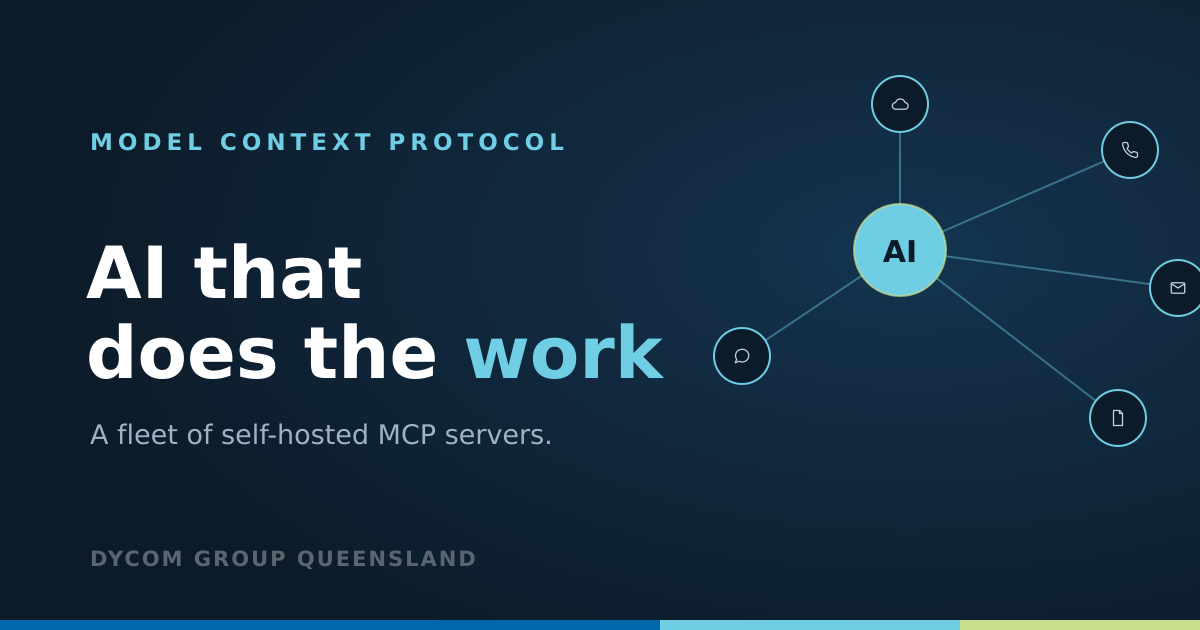
Most “AI for business” is a chatbot bolted to a help page. It can talk about your systems. It cannot touch them. The interesting line got crossed when assistants learned to use tools — and the plumbing that lets them do it safely is called the Model Context Protocol, or MCP.
An MCP server is a bridge. On one side, an assistant like Claude. On the other, a real system: your phones, your mailbox, your files. Ask a question in plain English; the server does the work in the actual software and hands back the answer. Over the past few months we have built seven of them, and running a fleet teaches you things that building one does not.
The easy 20% and the hard 80%
Wiring an assistant to an API and getting it to read data is an afternoon's work. Making it safe enough to point at a live business system is the rest of the month. That is where the real engineering lives, and it is the part most “integrations” skip.
Our 3CX server is a good example. It will read a phone system all day — extensions, queues, call history with summaries and sentiment. But the moment a tool can change something, move an agent or re-point an inbound rule, the rules change. Every write is preview-then-confirm: the assistant shows you exactly what it is about to do, and nothing happens until you say so. Everything it does lands in an audit log. There is a hard line between reading and acting, and the acting side is fenced.
Self-hosted, on purpose
The Microsoft 365 server makes the point clearest. It has delegated access to a signed-in user's mail, calendar, Teams and files. That is not something you hand to a random cloud service and hope. So it runs on infrastructure we control, the credentials never leave it, and it is locked down the way anything holding those keys should be: no root, firewalled so only the reverse proxy can reach it, a self-contained login where every connection is approved by hand, and an emergency key that wipes its stored credentials for a clean start. An assistant that can read your mailbox is enormously useful and slightly terrifying, and the difference between those two comes down to where it runs and who holds the keys.
Build it once, ship it many times
The other thing a fleet teaches you is to package. Each server is built so it can be stood up from a single image and a web setup page, with no secrets baked in — so what starts as our own tool becomes something we can hand to a client and support. The 3CX server we run against our own phones is the same one a client runs against theirs.
What it means for you
Bluntly: if a system in your business has an API, and most now do, there is a good chance an assistant can be given a safe front door to it. The dull, repetitive, read-from-one-screen-and-type-into-another work is exactly what this is for. We do not build the version that can quietly go wrong; we build the version with the fence, the audit trail and the off switch. That is the difference between talking about AI and building with it.